|
|
A Lesson In Grace
The boy stood with back arched, head cocked back and hands clenched defiantly. "Go ahead, give it to me." The principal looked down at the young rebel. "How many times have you been here?" The child sneered rebelliously, "Apparently not enough." The principal gave the boy a strange look. "And you have been punished each time have you not?" "Yeah, I been punished, if that's what you want to call it." He threw out his small chest, "Go ahead I can take whatever you dish out. I always have." "And no thought of your punishment enters your head the next time you decide to break the rules does it?" "Nope, I do whatever I want to do. Ain't nothing you people gonna do to stop me either."
The principal looked over at the teacher who stood nearby. "What did he do this time?" "Fighting. He took little Tommy and shoved his face into the sandbox." The principal turned to look at the boy, "Why? What did little Tommy do to you?" "Nothing, I didn't like the way he was looking at me, just like I don't like the way your looking at me! And if I thought I could do it, I'd shove your face into something." The teacher stiffened and started to rise but a quick look from the principal stopped him.
He contemplated the child for a moment and then quietly said, "Today my young student, is the day you learn about grace." "Grace? Isn't that what you old people do before you sit down to eat? I don't need none of your stinken grace." "Oh but you do." The principal studied the young mans face and whispered. "Oh yes, you truly do..."
The boy continued to glare as the principal continued, "Grace, in its short definition is unmerited favor. You cannot earn it, it is a gift and is always freely given. It means that you will not be getting what you so richly deserve." The boy looked puzzled. "Your not gonna whoop me? You just gonna let me walk?" The principal looked down at the unyielding child. "Yes, I am going to let you walk."
The boy studied the face of the principal, "No punishment at all? Even though I socked Tommy and shoved his face into the sandbox?" "Oh, there has to be punishment. What you did was wrong and there are always consequences to our actions. There will be punishment. Grace is not an excuse for doing wrong." "I knew it," Sneered the boy as he held out his hands. "Lets get on with it."
The principal nodded toward the teacher. "Bring me the belt." The teacher presented the belt to the principal. He carefully folded it in two and then handed it back to the teacher. He looked at the child and said. "I want you to count the blows." He slid out from behind his desk and walked over to stand directly in front of the young man. He gently reached out and folded the child's outstretched, expectant hands together and then turned to face the teacher with his own hands outstretched.
One quiet word came forth from his mouth. "Begin." The belt whipped down on the outstretched hands of the principal. Crack! The young man jumped ten feet in the air. Shock registered across his face, "One" he whispered. Crack! "Two." His voice raised an octave. Crack! "Three..." He couldn't believe this. Crack! "Four." Big tears welled up in the eyes of the rebel.
"OK stop! That's enough. Stop!" Crack! Came the belt down on the callused hands of the principal. Crack! The child flinched with each blow, tears beginning to stream down his face. Crack! Crack!
"No please," the former rebel begged, "stop, I did it, I'm the one who deserves it. Stop! Please. Stop..." Still the blows came, Crack! Crack! One after another. Finally it was over. The principal stood with sweat glistening across his forehead and beads trickling down his face. Slowly he knelt down. He studied the young man for a second and then his swollen hands reached out to cradle the face of the weeping child.
"Grace..."
Read
{ John 1:14 - 17 }
Author Unknown
FOOTPRINTS....
Imagine you and the Lord Jesus are walking down the
road together. For much of the way, the Lord's
footprints go along steadily, consistently, rarely
varying the pace. But your footprints are a
disorganized stream of zigzags, starts, stops,
turnarounds, circles, departures, and returns.
For much of the way, it seems to go like this, but
gradually your footprints come more in line with the
Lord's, soon paralleling His consistently. You and
Jesus are walking as true friends!
This seems perfect, but then an interesting thing
happens: Your footprints that once etched the sand
next to Jesus' are now walking precisely in His
steps. Inside His larger footprints are your smaller
ones, you and Jesus are becoming one.
This goes on for many miles, but gradually you
notice another change. The footprints inside the
large footprints seem to grow larger. Eventually
they disappear altogether. There is only one set of
footprints they have become one.
This goes on for a long time, but suddenly the
second set of footprints is back. This time it seems
even worse! Zigzags all over the place. Stops.
Starts. Gashes in the sand. A veritable mess of
prints.
You are amazed and shocked. Your dream ends. Now you
pray: "Lord, I understand the first scene with
zigzags and fits. I was a new Christian; I was just
learning. But you walked on through the storm and
helped me learn to walk with you."
" That is correct." " ... And when the smaller
footprints were inside of Yours, I was actually
learning to walk in Your steps; followed you very
closely." "Very good. You have understood everything
so far." " ...
When the smaller footprints grew and filled in
Yours, I suppose that I was becoming like you in
every way." "Precisely." "So, Lord, was there a
regression or something? The footprints separated,
and this time it was worse than at first."
There is a pause as the Lord answers with a smile in
his voice. "You didn't know? That was when we
danced."
Author Unknown
|
|
|
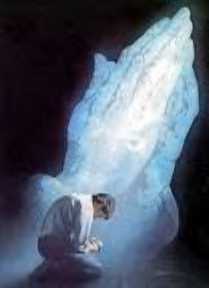
The Story Behind The Picture of "The Praying Hands"
Back in the fifteenth century, in a tiny village near Nuremberg, lived a
family with eighteen children. Eighteen! In order merely to keep food on
the table for this mob, the father and head of the household, a
goldsmith by profession, worked almost eighteen hours a day at his trade
and any other paying chore he could find in the neighborhood. Despite
their seemingly hopeless condition, two of Albrecht Durer the Elder's
children had a dream. They both wanted to pursue their talent for art,
but they knew full well that their father would never be financially
able to send either of them to Nuremberg to study at the Academy.
After many long discussions at night in their crowded bed, the two boys
finally worked out a pact. They would toss a coin. The loser would go
down into the nearby mines and, with his earnings, support his brother
while he attended the academy. Then, when that brother who won the toss
completed his studies, in four years, he would support the other brother
at the academy, either with sales of his artwork or, if necessary, also
by laboring in the mines. They tossed a coin on a Sunday morning after
church. Albrecht Durer won the toss and went off to Nuremberg.
Albert went down into the dangerous mines and, for the next four years,
financed his brother, whose work at the academy was almost an immediate
sensation. Albrecht's etchings, his woodcuts, and his oils were far
better than those of most of his professors, and by the time he
graduated, he was beginning to earn considerable fees for his
commissioned works.
When the young artist returned to his village, the Durer family held a
festive dinner on their lawn to celebrate Albrecht's triumphant
homecoming. After a long and memorable meal, punctuated with music and
laughter, Albrecht rose from his honored position at the head of the
table to drink a toast to his beloved brother for the years of sacrifice
that had enabled Albrecht to fulfill his ambition. His closing words
were, "And now, Albert, blessed brother of mine, now it is your turn.
Now you can go to Nuremberg to pursue your dream, and I will take care
of you." All heads turned in eager expectation to the far end of the
table where Albert sat, tears streaming down his pale face, shaking his
lowered head from side to side while he sobbed and repeated, over and
over, "No ...no ...no ...no."
Finally, Albert rose and wiped the tears from his cheeks. He glanced
down the long table at the faces he loved, and then, holding his hands
close to his right cheek, he said softly, "No, brother. I cannot go to
Nuremberg. It is too late for me. Look ... look what four years in the
mines have done to my hands! The bones in every finger have been smashed
at least once, and lately I have been suffering from arthritis so badly
in my right hand that I cannot even hold a glass to return your toast,
much less make delicate lines on parchment or canvas with a pen or a
brush. No, brother ... for me it is too late."
More than 450 years have passed. By now, Albrecht Durer's hundreds of
masterful portraits, pen and silver-point sketches, watercolors,
charcoals, woodcuts, and copper engravings hang in every great museum in
the world, but the odds are great that you, like most people, are
familiar with only one of Albrecht Durer's works. More than merely being
familiar with it, you very well may have a reproduction hanging in your
home or office.
One day, to pay homage to Albert for all that he had sacrificed,
Albrecht Durer painstakingly drew his brother's abused hands with palms
together and thin fingers stretched skyward. He called his powerful
drawing simply "Hands," but the entire world almost immediately opened
their hearts to his great masterpiece and renamed his tribute of love
"The Praying Hands."
The next time you see a copy of that touching creation, take a second
look. Let it be your reminder, if you still need one, that no one - no
one - ever makes it alone!
Author Unknown
|
|
|
PRINTS OF ELBOWS ON MY BED
I was but a youth and thoughtless,
As all youths are apt to be;
Though I had a Christian mother
Who had taught me carefully.
There came a time when pleasure
Of the world came to allure,
And I no more sought the guidance
Of her love so good and pure.
Her tender admonitions fell
But lightly on my ear,
And for the gentle warnings
I felt an inward sneer.
But Mother would not yield her boy
To Satan's sinful sway,
And though I spurned her counsel
She knew a better way.
She made my room an altar,
A place of secret prayer,
And there she took her burden
And left it in His care.
And morning, noon and evening
By that humble bedside low,
She sought the aid of Him who
Understands a mother's woe.
And I went my way unheeding,
Careless of the life I led,
Until one day I noticed
Prints of elbows on my bed.
Then I saw that she had been there
Praying for her wayward boy,
Who for love of worldly pleasure
Would her peace of mind destroy.
Long the conflict raged within me,
Sin against my Mother's prayers,
Sin must yield - for Mother never
While she daily met Him there.
And her constant love and patience
Were like coals upon my head,
Together with the imprints
Of her elbows on my bed.
And so at last the fight was won,
And I to Christ was led,
And Mother's prayers were answered
By her elbows on my bed.
Author Unknown
|
 |
Cherish Each Moment As the late afternoon sunlight came streaming in through the classroom windows and the class was nearly over, a teacher whose husband had died suddenly of a heart attack, moved a few things aside on the edge of her desk and sat down there to share some of her insight with her class. With a gentle look of reflection on her face, she paused and said, "Before class is over, I would like to share with all of you a thought that is unrelated to class, but which I feel is very important. Each of us is put here on earth to learn, share, love, appreciate and give of ourselves. None of us knows when this fantastic experience will end. It can be taken away at any moment. Perhaps this is God's way of telling us that we must make the most out of every single day."
Her eyes beginning to water, she went on, "So I would like you all to make me a promise."
"From now on, on your way to school, or on your way home, find something beautiful to notice. It doesn't have to be something you see -- it could be a scent-perhaps of freshly baked bread wafting out of someone's house, or it could be the sound of the breeze slightly rustling the leaves in the trees, or the way the morning light catches one autumn leaf as it falls gently to the ground. Please look for these things, and cherish them. For, although it may sound trite to some, these things are the 'stuff' of life. The little things we are put here on earth to enjoy. The things we often take for granted. We must make it important to notice them, for at any time ... it can all be taken away." The class was completely quiet. We all picked up our books and filed out of the room silently.
That afternoon, I noticed more things on my way home from school than I had that whole semester.
Every once in a while, I think of that teacher and remember what an impression she made on all of us, and I try to appreciate all of those things that sometimes we all overlook. Take notice of something special you see on your lunch hour today. Go barefoot. Or walk on the beach at sunset. Stop off on the way home tonight to get a double-dip ice cream cone. For as we get older, it is not the things we did that we often regret, but the things we didn't do. Life is not measured by the number of breaths we take, but by the moments that take our breath away.
Author Unknown
|
|